
Scientist Denies Circumcising Infants in Africa, Records Show Otherwise
"We're not doing infant circumcision," Dr. Robert Bailey asserts, while his clinic performs hundreds of them every year.
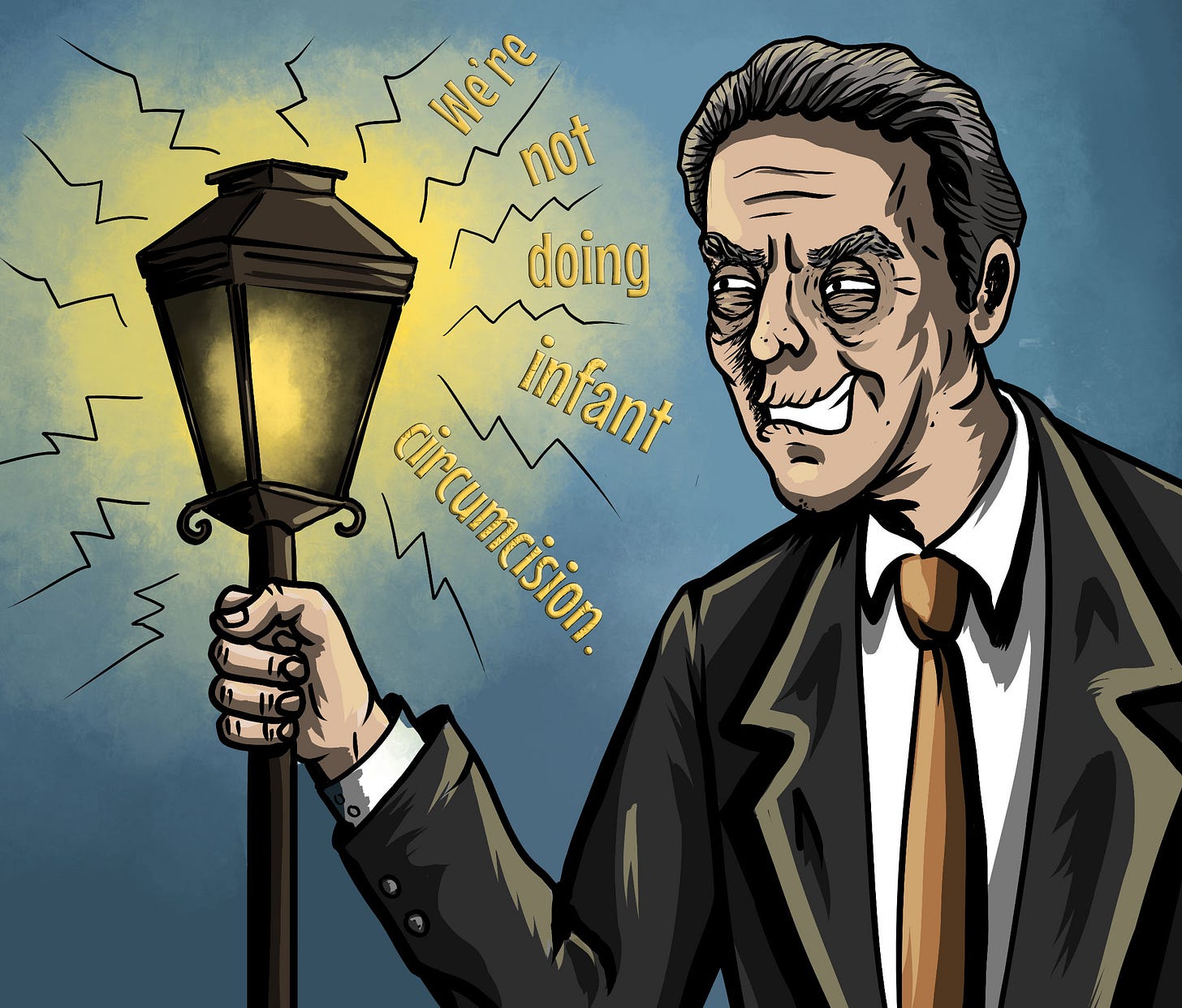
In a recent interview with The Daily Illini, Professor Robert Bailey, a key figure behind the mass-scale circumcision programs in Sub-Saharan Africa, made a few puzzling statements that are plainly at odds with readily available information.
Dr. Bailey helmed one of three Randomized Controlled Trials in the early 2000s that have since formed the controversial basis for circumcising 27 million infants, young boys, and men across the continent. Around that time, he also co-founded the Nyanza Reproductive Health Society (NRHS) in Kisumu, Kenya, and currently sits on its Board of Directors. This non-profit has since received over $14.2 million from the U.S. government in support of its ambitious circumcision programs.
Critics have raised issues with these programs, characterizing them as neocolonial human experimentation because of their coerciveness, lack of ethical standards, and inclusion of infants and small boys.
Weaving a tangled web
Dr. Bailey was asked by The Daily Illini about his work in Kenya, and he made a surprising denial.
We spend a lot of time counseling and telling young men the risks and the benefits of circumcision, we’re not doing infant circumcision.
When Punch Up Press called the NRHS this week and asked if they perform infant circumcisions, their staff answered in the affirmative. This was confirmed by a separate email inquiry. They also told us the service is provided free of charge, which implies it is likely subsidized by a governmental or charity program. This is a direct contradiction to Dr. Bailey’s recent claims.
In a planning document outlining their projected activities through 2025, they include “infants and children” on their list of clients, and indicate that “early infant male circumcision” is amongst their “needs and expectations”.
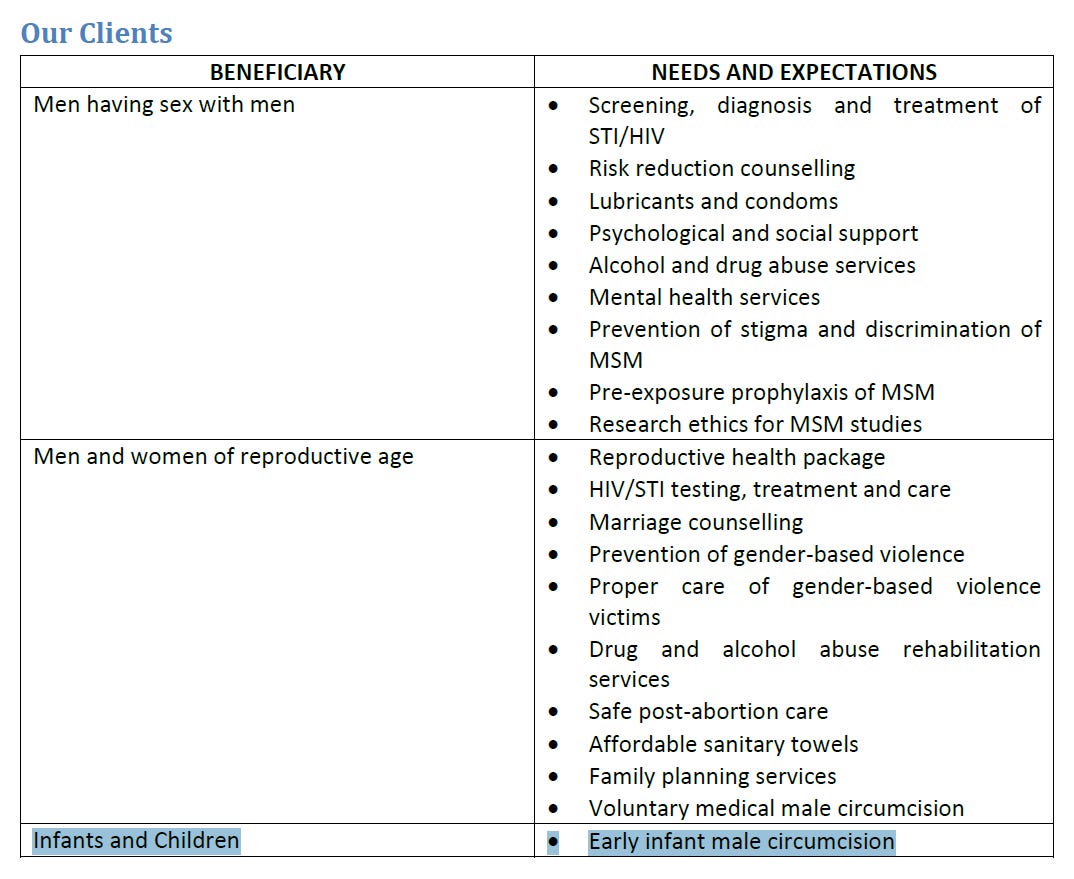
From the document titled “STRATEGIC PLAN 2021-2025”
The NRHS boasts that they “spearheaded” infant circumcision efforts in Kenya and that, according to their most recent annual report, put 278 little ones under the knife in 2021. They also tout their esteemed reputation for delivering this medically unnecessary surgery for newborns, stating in the report, “NRHS has contributed to the national and international scale-up of EIMC through the development and application of safe, infant male circumcision techniques and devices. The society is widely known for its skill and expertise in EIMC.”
Bailey’s claim that he and his colleagues don’t circumcise infants when the NRHS clearly does is a most curious contradiction.
Infants have long been targeted
In addition to claiming that infants are not currently being circumcised, Bailey implied they never were. “We’ve now done 28 million circumcisions of young men in 13 different countries in sub-Saharan Africa,” he told the Daily Illini reporter. Through clever omission, this impresses that only adolescents have been affected.
The facts, however, bear out quite differently. Since their inception, the Voluntary Medical Male Circumcision (VMMC) campaigns not just in Kenya, but across Africa, have included infants. These efforts have a long and storied history in the region.
In 2010, the WHO published a manual for this surgery on babies, crafting a new moniker in the process, Early Infant Male Circumcision (EIMC). Professor Bailey, himself swept up in the EIMC furor of the time, has written voluminously in favor of it.
A 2014 WHO report beckoned public health agencies to focus on newborns in order to increase uptake.
Several countries…have begun to [increase circumcision rates] by focusing on cohorts of adolescents and infants. This transition has implications for [our] work…which must increasingly turn toward adolescent and infant procedures.
This spurred the Kenyan government to set a target of circumcising 40% of all hospital-born infants, which has been maintained at least up until 2021. This policy sought to “make male circumcision the norm in all Kenyan communities in (Nyanza), regardless of cultural background.”
A 2016 conference held by John Snow International, a big player in global public health, provides additional insight into these efforts to circumcise infants in Africa. For example, UNICEF’s Dr. Tin Tin Sint listed infant circumcision as a means of sustaining the “gains” of VMMC programs.
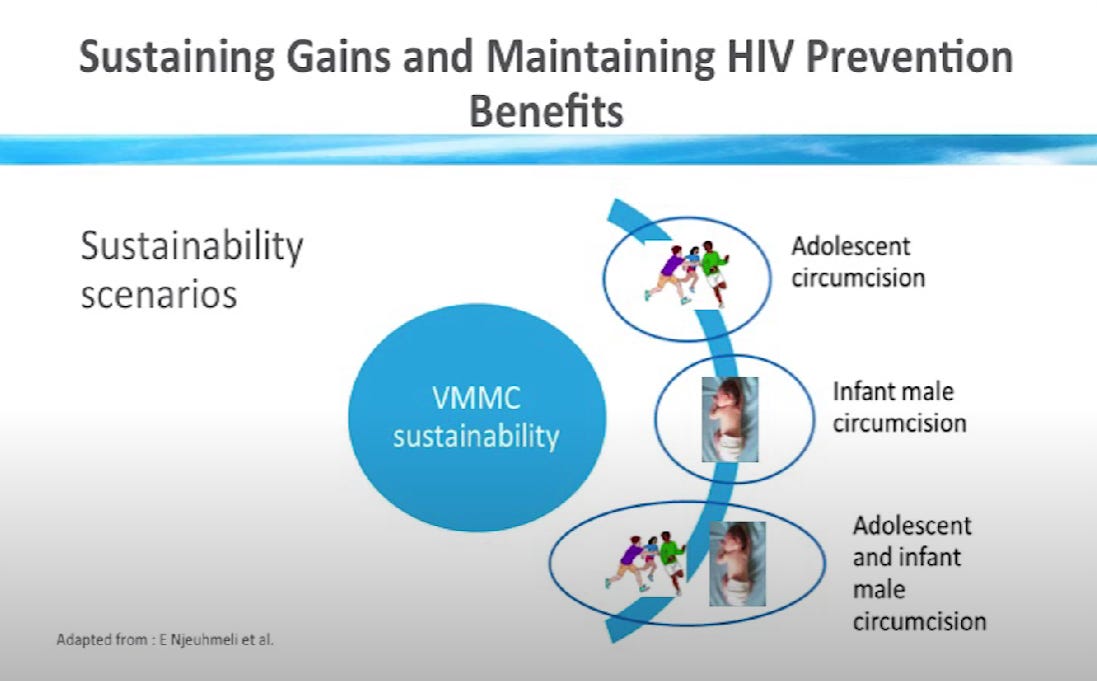
Infants and children were included in this “sustainability” strategy for ubiquitous circumcision
Another presenter described this focus on infants in Machiavellian terms, “If we can do the job well in infants then we won’t have to continue to invest in approaches that only target adults. That’s much more complicated than using the maternal child health services that are out there to circumcise infants.”
The subtext is that infants must be targeted because they are easier to circumcise at scale. Adults would need to be cajoled and convinced, which takes time and money, and isn’t as easily sustained.
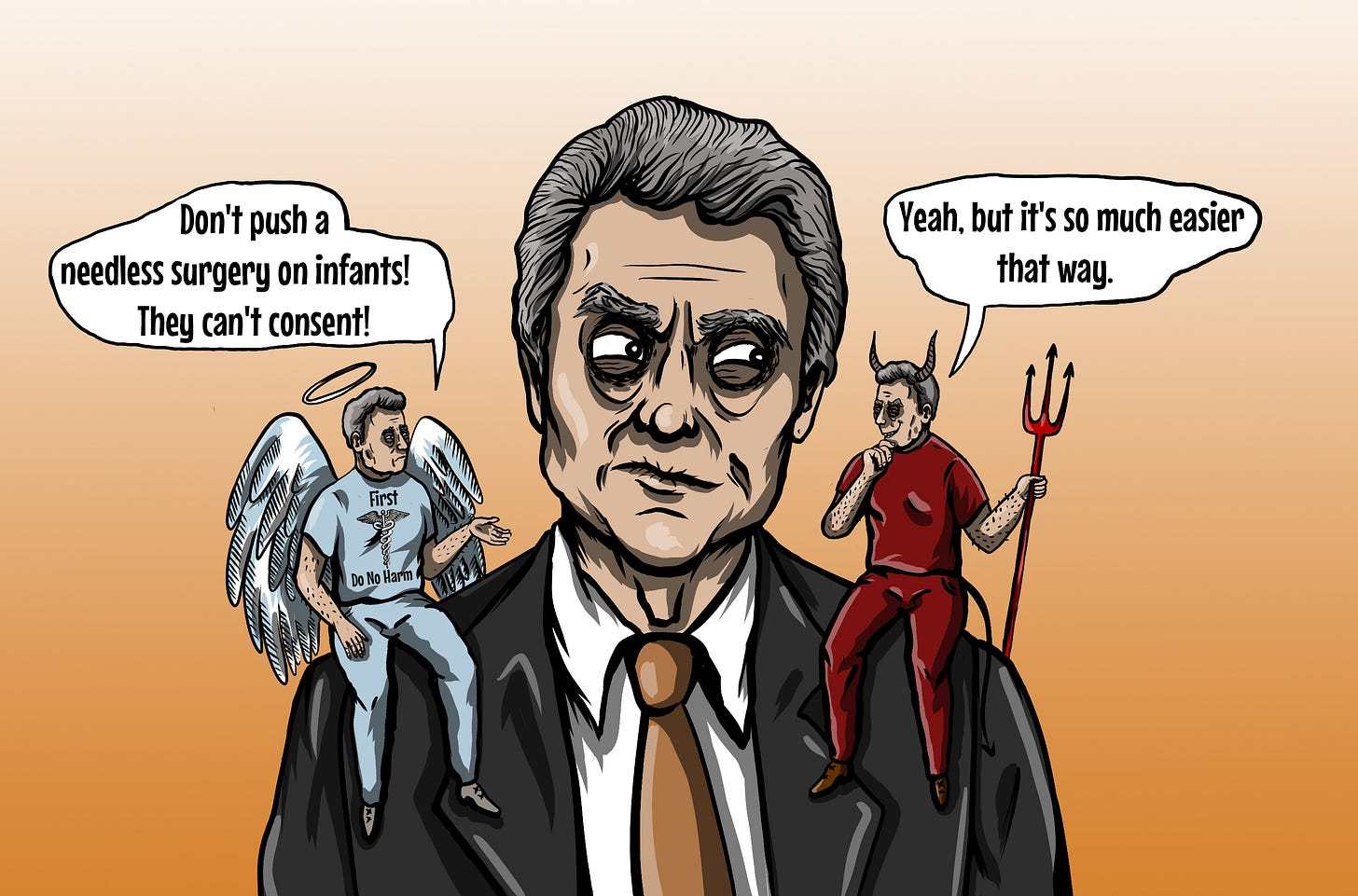
Illustration by Olga Kovina
Dr. Katharine Kripke echoed this imperative, stressing the upcoming generation should be targeted when they’re young. “We need to invest for the future, which means circumcising adolescents and infants and making sure that we can maintain the level of coverage that we achieve,” she demanded, “because if we don’t…then when we’re done circumcising the adults we’re just going to be back where we started.”
In breaking up the unanimity of the conference, a Swedish activist offered some pushback. “I was provoked by the way you talk about voluntary male circumcision,” he protested, “especially when you talk about doing it to infants and ten-year-olds. How can that even be voluntary when it’s done on children? What are the ethical considerations?”
The panelist gave up the game with her response, abandoning any pretense that these children are willing participants. “I think it’s important for us to always think about the best interest of the child…the reality really is that it’s either you do something or you don’t.”
When infants and children are targeted, the thin charade that these programs are voluntary quickly melts away.
A fawning moral epiphany
When Dr. Bailey was asked in his Daily Illini interview about his critics, he claimed they were “misguided”, and parried their concerns by suggesting they are mistaken and that he genuinely cares about the rights of infants. So burns the gaslight…
The benefit of adolescent circumcision is that at least you can get informed assent from an adolescent…My major misgiving about infant circumcision is…when you’re permanently altering someone without their consent, I think that raises ethical questions.
The sincerity of this claim is questionable, however, since it is inconsistent with his previously published articles and conduct over the years. His writings include explicit appeals to ignore the ethical concerns of infant circumcision, sometimes without even attempting to explain why.
In his earlier days of circumcision advocacy, he co-wrote a 1998 article in which similar concerns were brushed off by fallaciously likening circumcision to vaccines.
While some argue against performing neonatal circumcision without the affected newborn male’s consent…Removal of the foreskin could be viewed as preventive care, analogous to other procedures, such as immunisation, which are administered to children without their consent.
Critics, however, suggest there’s little comparison. Inoculants have proven causal mechanisms, which for circumcision have never been established, and they don’t involve the destruction of healthy, living tissue.
This wasn’t an isolated plea. Last year Dr. Bailey co-authored a Lancet article promoting a device, the Shang Ring, that perhaps he thought could allay the safety concerns of circumcision financiers. In it, he and his colleague beckoned their readers to neglect the very ethical concerns that he now professes to care for.
Leaving aside questions around the ethics of removing living tissue from individuals who are unable to provide informed consent…Early experiences with rare severe and lethal EIMC adverse events (AEs) in these settings…have discouraged donor funding.
While Bailey claimed he cares about the rights of infants to bodily autonomy in his recent Daily Illini interview, both of his prior written statements regarding the ethics of infant circumcision directly contradict it. Furthermore, suggesting his critics are “misguided” by denying that he does what they accuse him of, while actively doing it, feels like a cheap Jedi mind trick.
These aren’t the droids you’re looking for… we aren’t circumcising infants… move along…
The birth of a salesman
This leads to another major discrepancy. Dr. Bailey has published voluminously on EIMC in recent years, particularly advocating for new and profitable inventions. His output makes respectable journals like The Lancet and PLOS One look like trade magazines for these clamp-and-blade-laden devices that induce nausea just from the sight of them.
- What device would be best for early infant male circumcision in east and southern Africa? (2017)
- Can the ShangRing bring us closer to endorsing early infant male circumcision in sub-Saharan Africa? (2022)
- Safety of over twelve hundred infant male circumcisions using the Mogen clamp in Kenya (2012)
- Field evaluation of the safety, acceptability, and feasibility of early infant male circumcision using the AccuCirc device (2018)
Each of these, unsurprisingly, follows a similar format which typically includes overstating the benefits of circumcision (while ignoring the fact that almost all of them are irrelevant to infants), declaring whatever device they’re looking at is both safe and effective, and that it should help in the overarching efforts to scale up EIMC. It’s an impressive formula for a sales pitch to try and win over all those nervous government pursers.
One even characterizes parental consent as a “challenge” to overcome. Another recommends “targeted efforts” to get parents to offer their newborns up for the surgery. Bailey rejoiced about one of these devices’ potential for driving up infant circumcision referrals.

He also wrote two articles that promote EIMC without focusing on a particular tool.
- Prospective comparison of two models of integrating early infant male circumcision with maternal child health services in Kenya (2017)
- Factors Associated with Preference for Early Infant Male Circumcision Among a Representative Sample of Parents in Homa Bay County, Western Kenya (2016)
One of them lauds the idea of “large scale EIMC” as a “sustainable, long-term solution” in support of “the Kenyan Government’s national strategy to scale up voluntary medical male circumcision includes plans to transition from adolescent and adult male circumcision (AMC) to predominantly EIMC.”
If Bailey has a “major misgiving” about infant circumcision, as he now claims, he has quite peculiar ways of showing it.
Reports on the ground
In 2017, the Austrian physician Dr. Jutta Reisinger volunteered in Bailey’s stomping grounds, Kisumu, for an international healthcare NGO. There, she witnessed horrific scenes of young boys, no older than 8, being summoned from the surrounding areas to have the surgery, which she called genital mutilation, despite their screams of protest. It was a process which, according to her account, at times involved insults and punches from the medical staff. She also claimed that consent from the boys or their parents was not sought or obtained. Instead, it was merely given by their school’s principal. These revelations garnered significant coverage in the German media.
This is also at odds with what Dr. Bailey told The Daily Illini, suggesting “It’s fully voluntary (for adolescents), there’s nothing coercive about it. They volunteer, they’re not paid and they’re informed about the risks and benefits of circumcision.”
A few years later, a German radio program investigated the issue, interviewing people on the ground in Western Kenya who reported terrifying cases of kidnapped young boys being taken to Kisumu to be circumcised. The report also covered a scheme at Dr. Bailey’s clinic of paying nurses and recruiters a pittance per head to pitch the surgery to men and in some cases, expecting mothers, for their newborns to go under the knife.
One such newborn circumcision was witnessed by the Deutschlandfunk reporter, who also interviewed Dr. Bailey. He plainly described the incentivization scheme, telling the reporter, “A nurse might get compensated 50 or 100 shillings (roughly fifty cents to a dollar) if she actually recruits a mother and a baby for infant circumcision.”
Despite Dr. Bailey’s recent suggestions that he cares about consent, he previously ran an incentive program that paid out less than a dollar per head to push it on mothers.
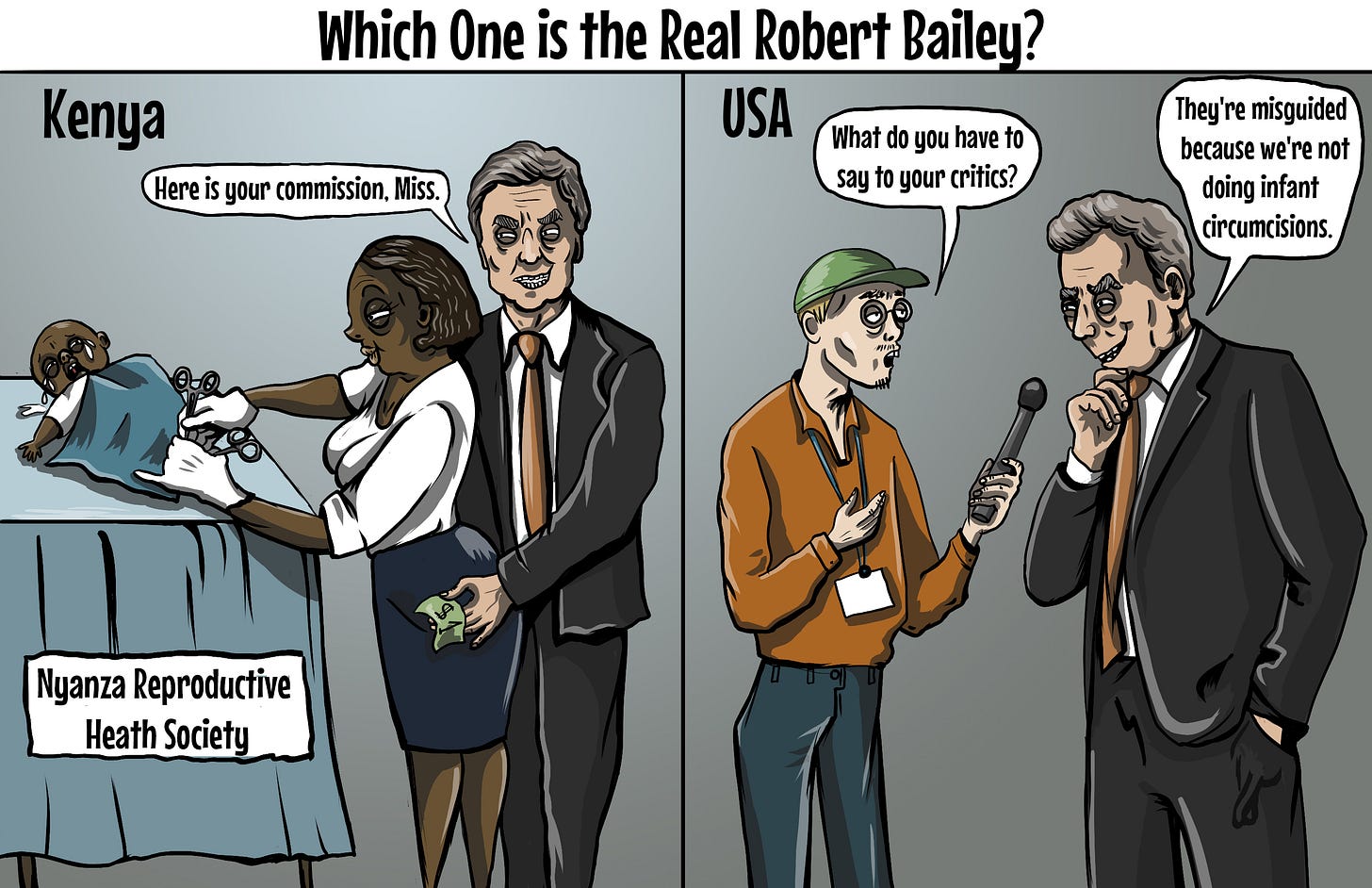
Illustration by Olga Kovina
If Dr. Bailey’s ethical concerns about infant circumcision are genuine, this could be a welcomed change and helpful in protecting the human rights of baby boys across Africa, and perhaps elsewhere as well. However, his recent statements are contradicted by his plentiful writings and the ongoing programs of his own clinic at the Nyanza Reproductive Health Society, which have been spared the memory hole, thanks to Google.
These discrepancies leave gaping accountability holes that could be filled by gainful action on his part, which could include a public denouncement of infant circumcision in Africa, much less his own country, as well as ceasing infant circumcisions at the NRHS. This would be a welcome alternative to gaslighting his critics by suggesting he’s not doing what they critique him for, when he clearly is.
Without taking such steps, his denials and claimed moral concerns fall flat, contributing to the overall culture of irresponsibility that has plagued circumcision proponents for decades.
Dr. Bailey did not respond to requests for comment.